Tuesday, April 26, 2011

Cedar Waxwings and Summer Tanagers


The cedar waxwings will be leaving for their nesting grounds any day. They finished stripping the holly tree by the horse pasture in about 3 days, and have been feeding at the edge of the woods, presumably on tulip tree flowers. They are so striking with their sleek yellow and fawn feathers and their black masks that look like a bold streak of paint.

They like to hang out in the blackgum trees, always very late
to leaf out, in between eating berries. You can hear their calls here.


I wonder if any of these birds will nest in the mountains of our state. Their breeding range extends from the NC mountains up to much of Canada.

The Red-Shouldered Hawks have chosen a conspicuous spot to nest this year: a pine tree just at the edge of the woods, equidistant between the old and current house sites. I noticed the hawks making a bunch of racket nearby, saw what looked like a raptor's nest and thought "No. Right there?" Sure enough, that's their nest. They're probably incubating the eggs right now.


Summer in central NC wouldn't be summer without the songs of summer tanagers and blue grosbeaks. We used to have both scarlet and summer tanagers but I haven't heard or seen a scarlet for 5 or 6 years now. A summer tanager still patrols his territory that includes the old house site. I got a couple of pictures of him as he flew from tree to tree and sang. They don't seem to fear people much. This one seemed to be thinking "sure, you can take my picture". For 3-4 years there was a Summer Tanager who hung out by the horse shelters a lot and was so tame I wondered if he was hand-raised. I almost expected him to land on my shoulder. The way he fluttered about so close made me think of the cartoon birds in the old Disney movies, and made it seem as though we were on the verge of switching over into some alternate enchanted reality.


Once the resident indigo buntings arrive the summer song repertoire will be complete. Indigo buntings love the heat and sing out in the open no matter how sunny and hot the weather.

You can hear the song and call of summer tanagers here. The ones on our farm sound more "southern"; the tempo of their song is slower. They're a little bit hoarser too, although overall they sound more musical. You can hear the indigo bunting here. They sound much like goldfinches except they sing in paired syllables rather than long strings of similar notes.


Sunday, April 24, 2011

Needed: More purple


I used to wonder about all of the fuss over Amsonia as I looked at the struggling pallid specimens in our new garden... until I saw a specimen of Hubricht's amsonia in full sun at the JC Raulston Arboretum, and then an Amsonia tabernaemontana deep in the dappled shade of a slough on our farm. It's all about location. The Hubricht's Amsonia at the Arboretum was full and lush and feathery, the perfect foliage plant. In contrast the Amsonia from our farm is a sickly yellow-green in full sun, and the true light blue flowers manage to clash with everything. Give it some shade and it's transformed. The foliage is a wonderful shade of blue-tinted green that is a perfect complement to the flowers.


Eastern bluestar (Amsonia tabernaemontana) from the farm


The Baptisias are beautiful long before the flowers are fully open.


Baptisia alba


Purple would really tie the true blue amsonia, red columbine and white baptisia together, don't you think?


Vetch is about the closest to pink or purple that grows in this part of my garden, but it can't grow among the columbine because it will smother them. It does look good growing up the old stalks of Panicum though.


The color of Eastern Columbine can be hard to reconcile with the rest of the garden, although I love the flower form. There is a pastel version but naturally it hasn't popped up where I want it, nor have the ones I have transplanted lived. If I can get this new crop of Baptisia going there will be plenty of purple, since most of my blue baptisia are actually purple.


In addition to the lavender and blue-violet of Blue Baptisia, bright purple would be just the thing.


I have some iris going there but they are the white and yellow iris from GH's grandmother's garden. They look great there too with the white Baptisia and the yellow petticoats of the columbine and a planned pairing no less, but something's still missing...

deep rich royal purple.


Iris kochii
Iris kochii is one of my favorite iris and one of my favorite flowers, although I think I say that about everything. I wish you could smell the fragrance ~ divine!

Wishing you and yours a Happy Easter!


Friday, April 22, 2011

So Much Going On


The tidal wave of spring has begun. Will the gardener successfully ride the wave or be engulfed? With all of these open sun gardens and the Lamium purpureum takeover I feel like I'm carving my gardens out of weeds every spring. I hope to get Lamium pastures going in the open spaces around the gardens next year. (It's not the Lamium I really mind, other than the fact that it's greedy. The Chickweed and Shotweed get all over my last nerve.) As always I feel I need more Baptisias and woody plants in the gardens below the house and that there can never be enough purple.

But first, the new leaves.

The new leaves of Serviceberry remind me of Pussy Willows; silvery and velvety and as pretty as the flowers which have faded just as the leaves emerge.


I love, love love Heuchera for foliage effect. The leaves are beautiful all growing season. This is Heuchera villosa and I even like the delicate late summer flowers, which remind me of a fancy grass bloom. The insects love them too.


Janet Queen of Seaford recently wrote a post about river birches, which grow in abundance in the floodway on our farm. I think these trees are their most beautiful in their youth, when their bank peels in elaborate scrolls and is colored in warm shades of pink, gold and fawn. Their leaves are most beautiful in the youth of the year.


I did not begin to capture much of the beauty of the new leaves this spring, like the golden bronzy new growth of the oak trees and the wisteria or the cool blue-green of iris foliage against the velvety bright green of Monarda.

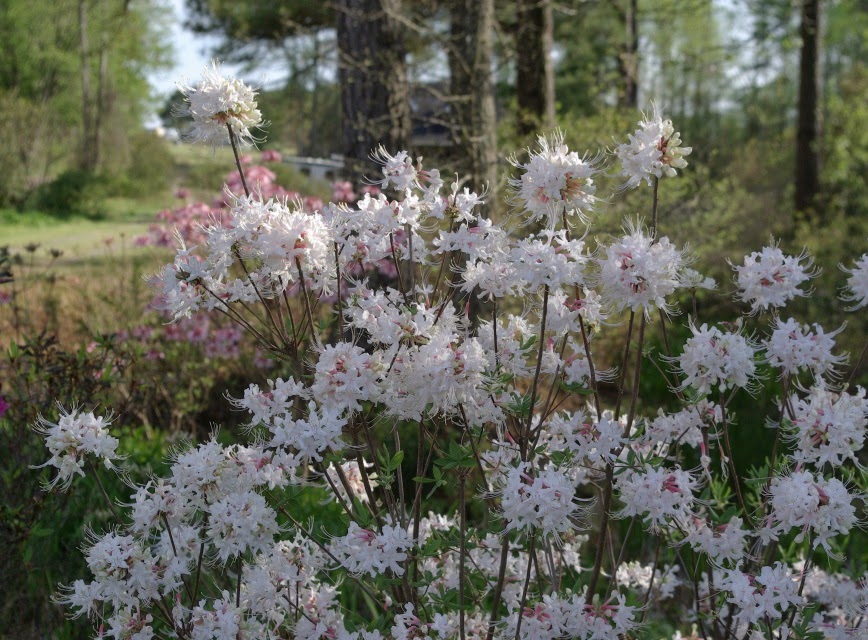
And then there are the azaleas. It's a little corner of my garden that reminds me of the sisters' garden for its colorfulness, although most of my azaleas are deciduous natives and almost all of theirs are evergreen.


Pink and white Piedmont azaleas


Semi-double evergreen pink from DH's grandmother's garden


Encore 'Autumn Amethyst' often doesn't have a whole lot of flowers in the spring ~ it tends to bloom much more in the fall here ~ but the color has a lot of impact.


The fuzzy buds of Coast Azalea

open to deliciously fragrant flowers.

More to come ~ there is a lot going on. I hope you are able to get out in the garden and enjoy spring.


Related Posts Plugin for WordPress, Blogger...