Tuesday, November 4, 2014

Fields of Gold


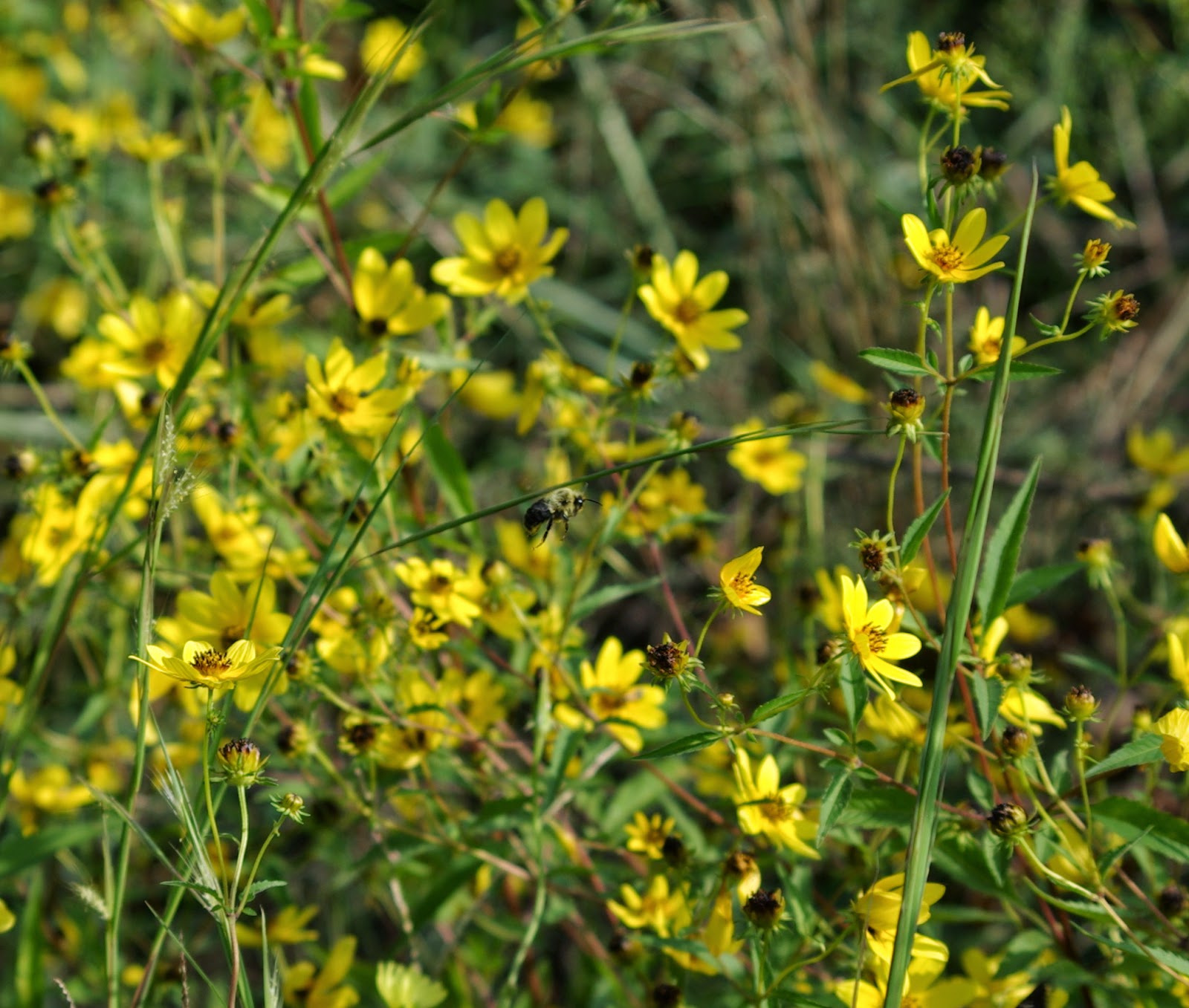
April/May and September are peak months in my garden. In September the big star is Bidens but there are other things in bloom too. All of that golden yellow needs some contrasts.

White and pink seashore mallow

Rose 'Caldwell Pink'

This year was a good year for Bidens, although not quite as good as last year.


I didn't get Bidens all up and down the ditches next to the pastures like I wanted, but there were enough next to one of the pastures to make a nice show. These pictures are from mid September.


Looking across the old front yard to the path up to the paddock behind the house.

Part of the old front yard

Encore azaleas and Bidens

Fiery skipper

Silver-spotted skipper


View from front porch

View from back porch

The plant with the brown seedheads next to the shavings pile is a native
spirea, Spirea tomentosa. It's a lovely plant and I need several more.
I am going to take some softwood cuttings after it blooms next year.


The little field up top


DH planted some tithonia and cosmos up there. He did that to make amends for mowing a section of the field closely (and possibly mowing down young Bidens) in the spring.


One of the first Monarchs of the season I saw nectaring from Bidens.


Carpenter bee


I can never get over how fast hoverflies can move. Their speed seems almost supernatural.


Cutest skipper ever - Fiery Skipper


Bumblebee

Rocket bumblebee


The Bidens have mostly gone to seed now, although there are a couple of oddball groups up top that are still blooming or just starting to bloom, more than a month after the rest. The goldfinches, song sparrows and song sparrows love the seeds. I've spent a few hours collecting seed and spreading them to try to get an even more expansive show next year.


Wednesday, October 22, 2014

Wildflower Wednesday


One of the first signs of fall here is when the wild persimmons trees turn... purple. Laurrie, of the blog "My Weeds are Very Sorry" has a wild persimmon of the same species that turns a bright golden orange, almost like a pumpkin. Very seasonal. Who wouldn't love a tree that turns that color? (Although she doesn't post on that blog anymore, she still has an online gardening journal that I read regularly.)

Persimmons are a common understory tree on our farm. They are handsome, striking even with their layers of slightly drooping dark green leaves; their leaves often look a though they are hung in festoons rather than on branches they are so thick. I sometimes think that a bomb would be necessary to kill one. One keeps shooting up in the pony's old stall in the shelter down in the pasture...for the past 14 years. Occasionally I see fruit but the leaves often hide them. As a kid Gene tried a persimmon from a tree on his grandparents' tobacco farm, picked too early from his description of the taste as the most sour thing you can imagine.

See? Purple. Or at least purplish. I like the purple. It's unique. The sweetgums turn purple too but usually more in shades of wine and burgundy before changing to red orange and yellow. But I wouldn't say no to a gold or orange persimmon tree either. If persimmon trees weren't so common I would buy one to see if I could get that pumpkin fall color, but they are literally weeds here.

The persimmons pictured above are next to the shelter paddock, and there are several next to the floodway fields too. The floodway fields have quite a lot of flowers this year thanks to plentiful rainfall over the last two summers. I won't mow these fields until early March. It's difficult to find a window to keep the saplings down and not mow the flowers and cover for wildlife.

From July: Rosepink (Sabatia angularis), an annual that blooms in midsummer and has very sweetly fragrant flowers. I've seen it blooming just 3" high in the ditches next to the grass road between the pastures, and this year 2 feet high in the field with the pond.

Meadow beauty grows all over the farm, from the edge of the woods up top to the floodway fields. Two different species grow here and their flowers in colors from pale to bright rose pink, Maryland meadow beauty (Rhexia mariana) and Virginia meadow beauty.(R. virginca). This is Rhexia virginca. R. mariana has thinner leaves and generally paler flowers. One of its common names is pale meadow beauty. Meadow beauty blooms from June/July to October.

Gerardia, goldenrod and Bidens. These pictures were taken in late September and early October.

Gerardia with rugose goldenrod.


I am always saying that I love things, and that they are one of my favorites, but I really do love Gerardia. Even if the name does sound like a dread disease. It's an annual that grows wild on the farm. It's part of a select clique of natives that grow here that I have not succeeded in growing in the garden and includes our native crabapple (Southern Crabapple Malus angustifolia), Sabatia, downy lobelia, and a lovely blue gentian called soapwort.

Gerardia tenufolia, so called because of its delicate wiry stems that turn burgundy as the flowers age, is also known as slender gerardia and false foxglove.


The sulfur butterflies and skippers looked to be feeding preferentially on the lobelia.

Silver-spotted skipper

Sulfur on lobelia

and on these pale butter yellow daisies.


Today I am joining Gail at clay and limestone for Wildflower Wednesday.

Saturday, October 11, 2014

Monarch Butterflies


Unlike last year, when I saw a grand total of 2 Monarch butterflies, I am seeing a lot of Monarch butterflies this year. They especially love Buddleia 'Potter's Purple'. On Wednesday I saw as many as 15 the two butterflies bushes in the big bed. They must have fueled up and moved on, as I didn't see many again until today.


Why were there so few last year and seemingly normal numbers this year I wonder?


Related Posts Plugin for WordPress, Blogger...