The flowers are just as important as the fruits and vegetables in our vegetable garden, since the garden is in a conspicuous place. A vegetable patch can be ugly in the middle of summer. Picture corn stalks falling over and tomatoes and cantaloupe vines running amok and then dying spectacularly. This ruining usually occurs in the middle of summer when I'm more concerned with avoiding heatstroke than tidying the vegetable garden after I've completed the rest of my chores.
In the beginning the vegetable garden was quite open.
2008


2009


The roses were small. This swamp rose is now over 6 feet tall.


So I planted a lot of seed grown Gulf Coast penstemon to fill in the gaps.


Belinda's Dream in 2008, before being grown over by the swamp rose and 'Veilchenblau'.


The flowers in the vegetable garden are around the perimeter, with the exception of the perennial sweet pea. We used a little metal stand for the sweet pea, which served its purpose for a couple of years before snapping off at the bottom in a wind storm. Later the sweet pea grew on the teepee with the Marabar spinach before that fell over too.


Lovely but not fragrant alas.


For a while there was also a Sombreuil rose on the wires
also meant for raspberry vines. The garden in 2010.

also meant for raspberry vines. The garden in 2010.


The picture below is from spring 2012. All of the roses have sized up except for 'Hansa'. Some of my rugosa hybrids (Hansa and my 'Therese Bugnet' seedling) had severe dieback over the winter last year. After a mild dry winter?? The TB seedling may be gone and the 'Hansa's are still struggling. I hope they don't come down with RRD this year. I've noticed some roses showing a decline before showing full-blown symptoms. Will have to wait and see.

See how much better Hansa looked in 2011?


These rugosas (seedlings of R. rugosa rubra and 'Hansa') need to be cut back to allow more room in the garden, but they do make a good hedge. Deer don't eat the rugosas here and the way the vegetable garden is designed/ has turned out there aren't many easy ways out, so I think they may help keep the deer out. If the deer were hungry enough they would eat everything, but that hasn't been the case so far.

'Pink Pillar' is one of the two truly warm-colored roses I have, both of which are climbers. 'Crepuscule' is the other one. The predominance of cool-colored roses is more the result of natural selection than personal choice, but this way the warm-colored roses make a lot of splash in an ocean of cool colors.


The combination of orange and candy pink somehow works with this rose.


The drainage in the part of the bed next to the drive is half dry, half wet, because the run-off from the roof of the house and from further up the hill runs down the edge of the bed and seeps under the rocks the keep the bed from washing out. The wild Indian strawberry loves the moisture and has formed a thick carpet on its own under the swamp rose and the other plants.

DH buried a 2" pipe that carries the overflow from one of the rain barrels to the edge of the
vegetable garden, next to the R. Palustris scandens. Louisiana iris 'Sinfonietta' thrives there.

vegetable garden, next to the R. Palustris scandens. Louisiana iris 'Sinfonietta' thrives there.


Broccoli, sweet peas, Antique Rose Emporium Rosa palustris scandens, rugosa, and 'Veilchenblau'.


R. palustris scandens


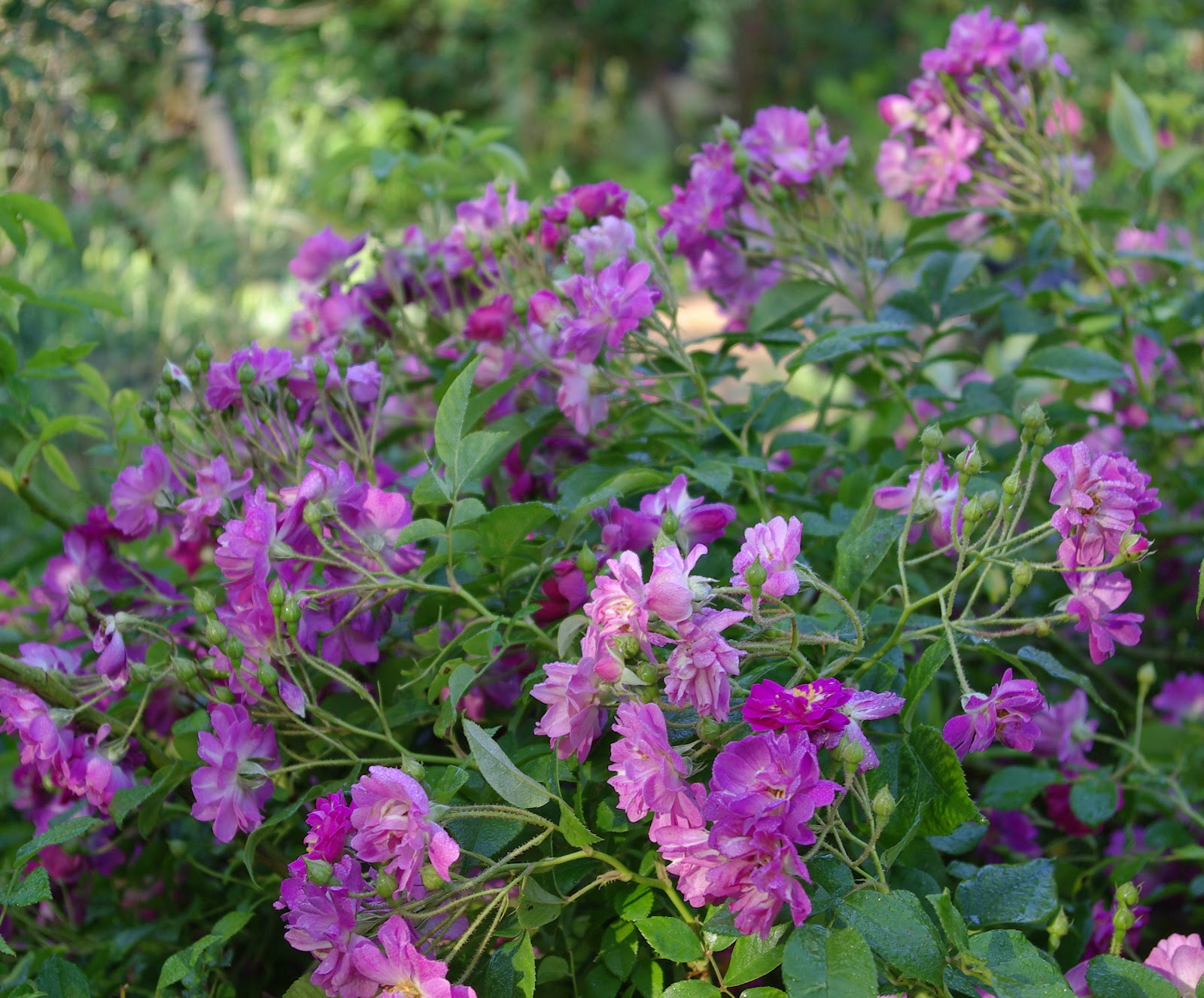
'Veilchenblau'




Buddleia 'Petit Indigo' is just far enough away from the edge to keep its toes out of the damp. As you can see the term "petit" is just for the size of the flower panicles and the leaves, not the actual size of the plant.

Hibiscus 'Anne Arundel', Phlox 'David's Lavender', and Formosa Lily. The hibiscus is a seedling of 'Anne Arundel'. I love the deep pink color of the flowers. The plant itself is tall and slender, unlike my light pink hibiscus which is more a round shape.

There's room for a few daylilies next to the driveway as well, although they're started to get a little crowded out.

'Pandora's Box'


I don't know the name of the pink daylily ~ it may be a seedling.


'Hyperion'


'Meriam White'


The north end of the bed gets a lot of moisture as the water that runs next to the bed at the edge of the drive turns and heads toward the ditch and eventually into Middle Creek. This area is home to seashore mallow, more daylilies,
Iris japonica,


amaryllis (Hippeastrum x johnsonii) and crinum. Crinum bulbispermum doesn't have a good fragrance but it's a striking plant, with its tall umbels of blooms and long curving tapered leaves. I bought it a few years ago at Plant Delights and stuck it in dry spot (ironically in the floodplain, on a small ridge that's still feet lower than where it is now), where it sulked. Once moved to richer, wetter soil it started putting up scapes of pink and white flowers with regularity.


Next to C. bulbispermum there is a white crinum and Crinum 'Ellen Bosanquet', a crinum from the 1920's that in my opinion may still be the loveliest out there. I got this crinum in a trade but am 99% sure this is Ellen based on the flowers, and although not apparent in these pictures, the distinctive ruffle-edged foliage. Both of my white crinums (a pure white from Niche that blooms early and 'Royal White' (C. digweedii), which blooms later and repeats) and Ellen are sweetly fragrant. Each one has a distinct perfume. The Niche crinum is just wonderfully sweet, 'Royal White' reminds me of Ivory soap (as does H. x johnsonii), and 'Ellen Bosanquet' has warm spicy undertones.


