Thursday, November 15, 2012

Fall, Part II


Hmmm, perhaps our fall color hasn't turned out to be so mediocre after all! Sandy did take away a lot of leaves, and at first most of the color we had was from a lone sassafras, a witch hazel, early-coloring wild blueberries, and wild sweet pepperbush that line the edge of the woods and the big ditch that runs behind the big perennial bed and beside the old house site. Last week I was thinking that I needed to add more things with fall color to the garden and maybe I'd been depending on the surrounding trees too much.

We have one good-sized sassafras on the farm, a wild one that grows near the edge of the
woods. It gets quite a bit of shade but still manages a beautiful shade of caramel gold each fall.


The coastal sweet pepperbush turned a rich yellow that lasted for 3 weeks. The leaves
are sensitive to frost and some years the show gets cut short, but not this year.


Sweet pepperbush and willowleaf aster 'Miss Bessie'. The
red shrub in the background is a blueberry starting to turn.


As I had hoped, the witch hazel has been reliably colorful every fall. It's a seedling of 'Jelena' (Hamamelis x intermedia), an orange-flowered hybrid of Japanese and Chinese witch hazels. It has yellow flowers (fine with me), hangs onto its leaves while it blooms (not fine with me), but I love it faults and all. It's a beautiful tree spring summer and fall and when it blooms in late winter it's very sweetly fragrant.


Hubricht's Amsonia turns a vivid shade of gold in the fall until a freeze turns it a more subdued bronze color.
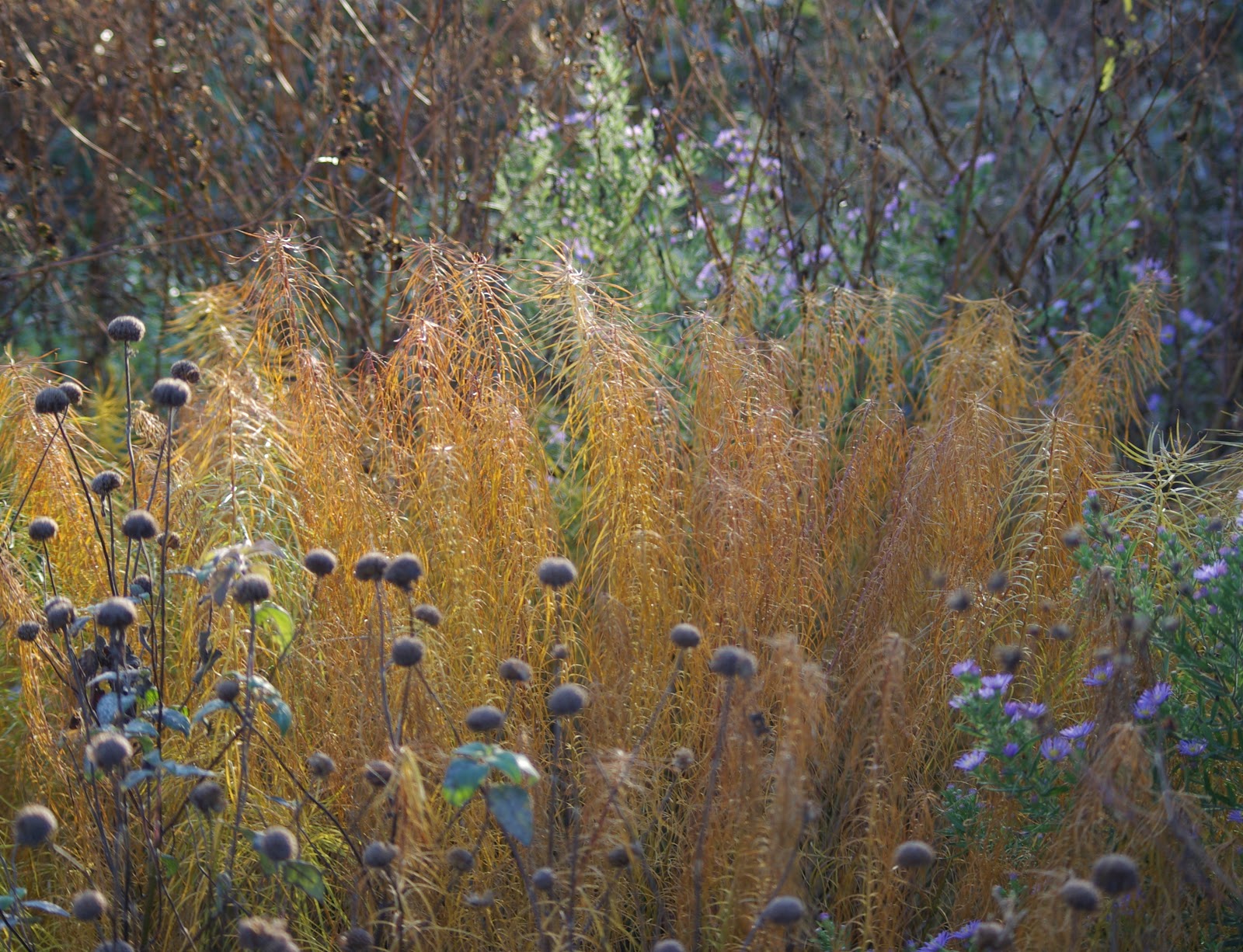

This Hubricht's/ Willowleaf hybrid hasn't turned as pure a yellow but is still lovely.


Then ~ the rugosas, many of which had set a beautiful crop of hips, began to turn color. How could I have forgetten? Gold, with some of the rubra and Hansas flushed with pink and rose. The smaller prairie rose (R. arkansana), Carolina and Virginia roses are even colored with yellow, orange, red and purple.


Some of the red maples just inside the wood's edge ~ which had been buffered from Sandy's wind by trees now stripped bare ~ started to turn wonderful colors of gold and peach and red.


This red maple on the property line managed to keep some leaves. It always turns a tangerine color. Red maples are highly variable overall. Some just turn yellow, others start out as yellow and add red, and a few are just pure blood red.

Next: The late turners.


Sunday, November 11, 2012

Fall Part I


We are having a fair to middling fall here, in terms of color. Sandy's outlying winds stripped off leaves that had a tenuous hold and so half the leaves are gone without having had the chance to turn. It's been a few years since we had a truly dazzling fall.


Top: just inside the woods next to the open space between the old and current house sites.
Bottom left, sassafras. Bottom right, coastal pepperbush.


The total effect is one of muted warm colors. There is still a lot of green.

Sensitive fern on the forest floor.


I'm not complaining about not having the most spectacular fall ever though. Sandy went around us, only giving us a couple of gray windy rains and a little rain, and the ratio of comfortable golden days to gray wintry days has been at least 4:1. There is still a lot of beauty in the landscape. The overall effect is of warm muted color. Alternating with the brown twigs of spent Bidens are the bright yellow-green leaves of aging Seashore Mallow and purple berries and asters, punctuated by splashes of brilliance: a young pawpaw that surprised us this year by turning a vivid yellow, the witch hazel painted with orange and red, an old gold Amsonia, a bright orange young Musclewood, and blueberries that have turned crimson.


South of the big perennial bed, near the ditch, is an area that is still semi-wild. I've planted a few divisions of willowleaf aster and a number of woody plants here ~ a sweetbay grown from seed, a baby wild blueberry transplanted from our woods, a swamp cyrilla grown from seed, and a half a dozen Antique Rose Emporium swamp roses grown from cuttings ~ but those plantings are young and relatively small still.


Swamp sunflowers and Encore azaleas.


I suppose the Bidens may look like a mess, but pictures don't capture the sweet cotton candy fragrance from the drying stems on warm sunny days, or the small twittering flocks of goldfinches, chipping sparrows and field sparrows that feed on the seeds.


The neighbor's miniature horses.


Seedheads of Sugarcane Plumegrass.


The pawpaw turned a rich shade of orange/brown after the first frost. As you can guess,
this area is not part of the garden, but a wild area that's mowed with the tractor once a year.

Sometimes the tangles outside of the garden bug me, but the wildlife loves them. In summer the Indigo Buntings sing above the brambles and the bobwhite quail flutter and glide from hedgerow to hedgerow. The turkey hen and her babies must have moved on to another area of their territory, as I haven't seen them for a few weeks, but just the other day I saw a covey of quail fly across the old house site, numbering at least 15 if not more than 20.

Monday, October 29, 2012

Late Asters


We have some fall color but the wind is playing havoc with the leaves. One of our chief trees for color in these parts is the red maple, which can be almost but not quite as spectacular as sugar maples. They are pretty sensitive to moisture levels though; a dry late summer and fall will squelch their fall show.

Members of the aster family are still going strong. Swamp sunflower is as sunny as ever.


I grew some zinnias from seed to liven up the plantings of tomatoes and lima beans. The lima beans are now growing rampantly after a hesitant start but never produced much. The sulfur butterflies like the zinnias.


Have I mentioned how much I love the purple of Aromatic asters?


The two pink dahlias have about half a dozen big flowers each. I never stake the dahlias because I never know whether they will make it through the summer, so their flowers always nod, but they are still beautiful. The dahlias would do best grown in pots, staked, and watered regularly. I may do that next year. Not sure about the winter storage though. I lost a lot when I tried storing them in pots under the house. I think the potting medium held too much moisture and the tubers stayed too wet. If you store dahlias over the winter what is your technique?


'Venus' is a late-flowering mum that never blooms in July or requires much care at all. Every October
I think I need to spread it around more and/or get some of the other late fall mums: 'Ryan's Pink' or 'Sheffield Pink' or 'Country Girl'. The bees and butterflies flock to these late season asters.


Red Admiral Butterfly


Monarch (top right) and Viceroy


The last three days we've had a lot of clouds and wind and last night we got almost 4/10ths of an inch of rain as Sandy made her way around us. At the coast many places got at least 8". For folks further north I sincerely hope that "frankenstorm" ends up being a Halloween hoax and not the real thing.


Related Posts Plugin for WordPress, Blogger...