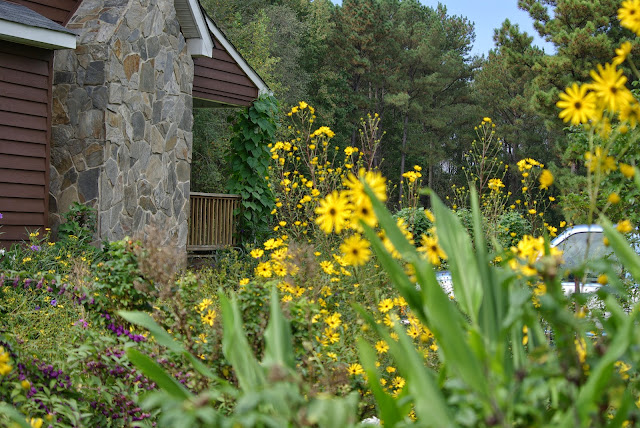
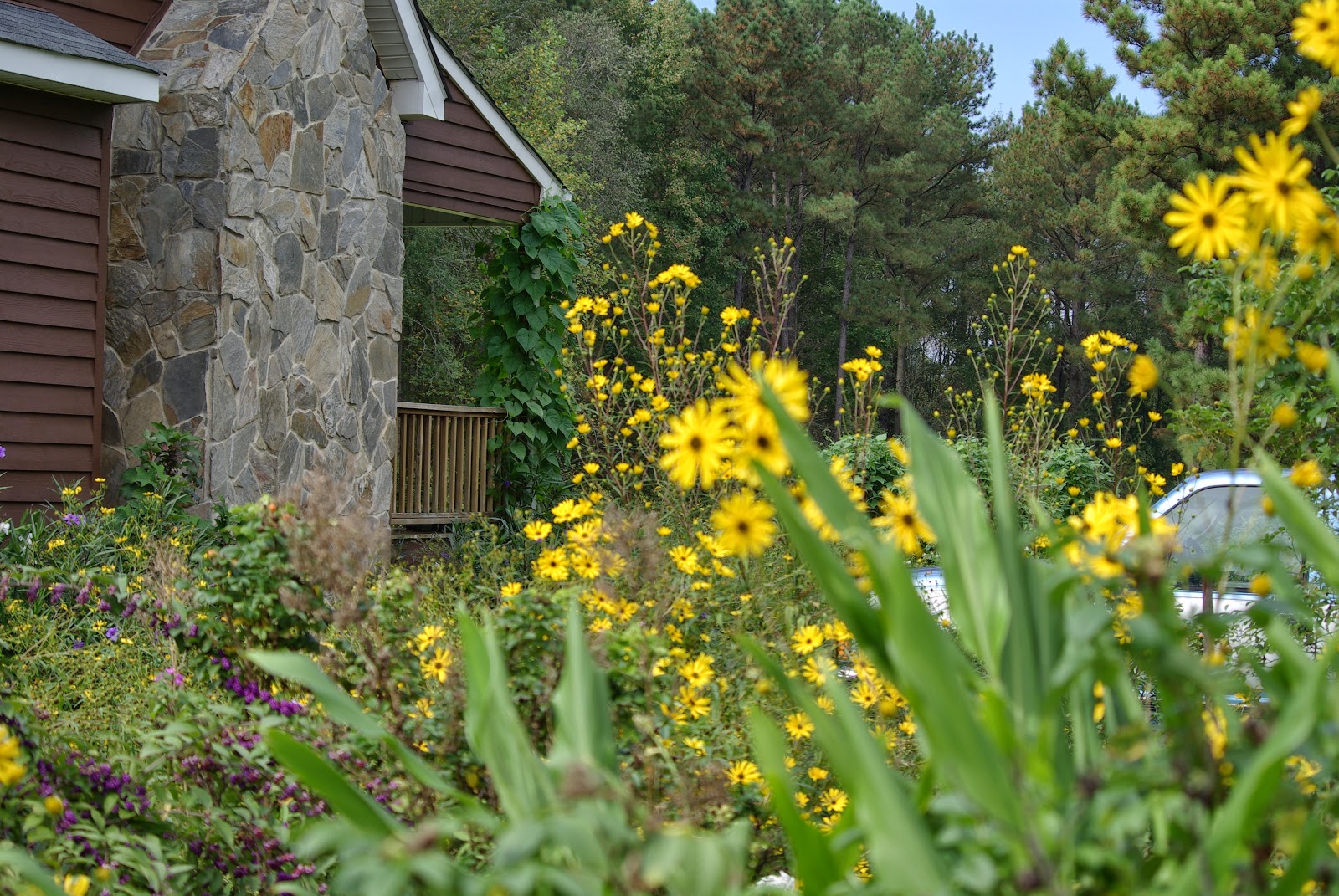
Swamp sunflower is the current undisputed queen of the October garden. The asters are starting with their magical soft purple blooms but what really catches the eye above the brown stems of the Bidens are the sunflowers. (Edited to add: Greggo commented that my sunflowers look like the willowleaf sunflowers native to the midwest, Helianthus salicifolius. To be honest I'm not entirely sure of the identity of my sunflowers. To begin, I have two types. The first four pictures feature a swamp sunflower that I bought from Niche Gardens years ago. It has wider leaves than my other sunflower, gets fungus on the bottom leaves, and blooms during the entire month of October. My other swamp sunflower was grown from seed from the NC Botanical Garden in Chapel Hill. It too grows tall but is much more likely to slump ~ albeit very gracefully ~ as it has less robust stems. No fungus but also doesn't bloom as long, 3 weeks as opposed to 4-5. Different species or differences within species?)


To further add to the confusion, I was reminded of something I read in an old Sunlight Gardens' catalog. So I pulled it out (I keep these catalogs as references), and it states that H. angustifolius typically grows to 1.5-5 feet. There's another species called tall narrow-leaved sunflower H. simulans. Here's what they wrote about it:
"This plant has been circulating in the trade as H. angustifolius, and when we first saw it, we thought it must be a giant form or even a tetroploid (genetically, extra well-endowed). But further research has confirmed its true identity to be H. simulans native to the southern coastal plain from Florida to Louisiana and up into Tennessee and Arkansas. It has narrow willowy leaves and easily reaches 8 feet in height. In mid-fall here, it explodes into flower and will cover itself with 3 inch bright yellow sunflowers."
So perhaps I don't have H. angustifolius at all, but H. simulans. I'm not sure. The two species could have been lumped together by now.


The swallowtails and hummingbirds are gone but there are still sulfurs, skippers, Monarchs and Viceroys around.


I have only one species of hardy ginger, in spite of our close proximity to Plant Delights, but to my mind the white one is the only one that counts since it has the best/ strongest fragrance. :) (Not to take anything away from the others, they are beautiful. But I only want to allocate so much room to very tropical-looking plants in my garden. If I lived on the coast of North Carolina or in southern South Carolina and southward, which are truly in subtropical zones, it'd be a different story...) The ginger started blooming in August and will continue until November.

I have unfortunately lost many dahlias the last few years. Most were grown from seed I got through a trade and were in almost every color of the rainbow. I'm not sure of the origins of this one but I really like it. It's the only dahlia blooming for me now.


This sweet aster just popped up in the big perennial bed one year. It's much taller than my white-flowered frost asters. I'm guessing willowleaf, although it's not as robust-looking and blooms a month earlier than 'Miss Bessie'.


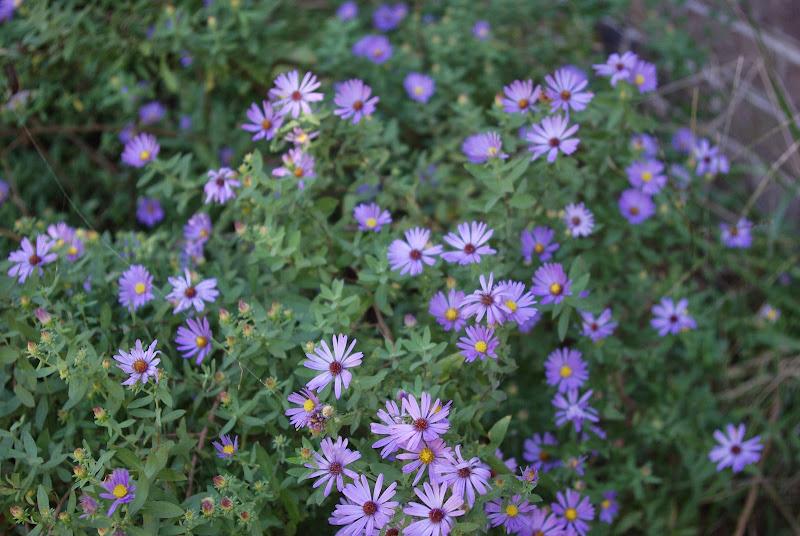
Shale aster. Love those purple flowers! I look forward to seeing the asters bloom all year and still want more. I lost my Georgia asters and large flower asters during wet winters. I also want the wild ones I see growing roadside. Not sure of the species but they are lovely. All of the species of purple-flowered asters have different shades of lavender and purple and all are beautiful.
Today I am joining Carol at May Dreams Gardens for Garden Bloggers' Bloom Day.
Niche Gardens swamp sunflower


To further add to the confusion, I was reminded of something I read in an old Sunlight Gardens' catalog. So I pulled it out (I keep these catalogs as references), and it states that H. angustifolius typically grows to 1.5-5 feet. There's another species called tall narrow-leaved sunflower H. simulans. Here's what they wrote about it:
"This plant has been circulating in the trade as H. angustifolius, and when we first saw it, we thought it must be a giant form or even a tetroploid (genetically, extra well-endowed). But further research has confirmed its true identity to be H. simulans native to the southern coastal plain from Florida to Louisiana and up into Tennessee and Arkansas. It has narrow willowy leaves and easily reaches 8 feet in height. In mid-fall here, it explodes into flower and will cover itself with 3 inch bright yellow sunflowers."
So perhaps I don't have H. angustifolius at all, but H. simulans. I'm not sure. The two species could have been lumped together by now.
Swamp sunflowers from the NC Botanical Garden.


This dainty swamp coreopsis is like a swamp sunflower in miniature.


The swallowtails and hummingbirds are gone but there are still sulfurs, skippers, Monarchs and Viceroys around.


A young purple coneflower putting out its first bloom this fall, very vibrant in the bright sunshine.


I have only one species of hardy ginger, in spite of our close proximity to Plant Delights, but to my mind the white one is the only one that counts since it has the best/ strongest fragrance. :) (Not to take anything away from the others, they are beautiful. But I only want to allocate so much room to very tropical-looking plants in my garden. If I lived on the coast of North Carolina or in southern South Carolina and southward, which are truly in subtropical zones, it'd be a different story...) The ginger started blooming in August and will continue until November.

I have unfortunately lost many dahlias the last few years. Most were grown from seed I got through a trade and were in almost every color of the rainbow. I'm not sure of the origins of this one but I really like it. It's the only dahlia blooming for me now.


This sweet aster just popped up in the big perennial bed one year. It's much taller than my white-flowered frost asters. I'm guessing willowleaf, although it's not as robust-looking and blooms a month earlier than 'Miss Bessie'.


Shale aster. Love those purple flowers! I look forward to seeing the asters bloom all year and still want more. I lost my Georgia asters and large flower asters during wet winters. I also want the wild ones I see growing roadside. Not sure of the species but they are lovely. All of the species of purple-flowered asters have different shades of lavender and purple and all are beautiful.

The roses are blooming, not with the exuberant bunches of
spring but spots of color here and there. This is 'Clotilde Soupert'.

spring but spots of color here and there. This is 'Clotilde Soupert'.

Today I am joining Carol at May Dreams Gardens for Garden Bloggers' Bloom Day.


